


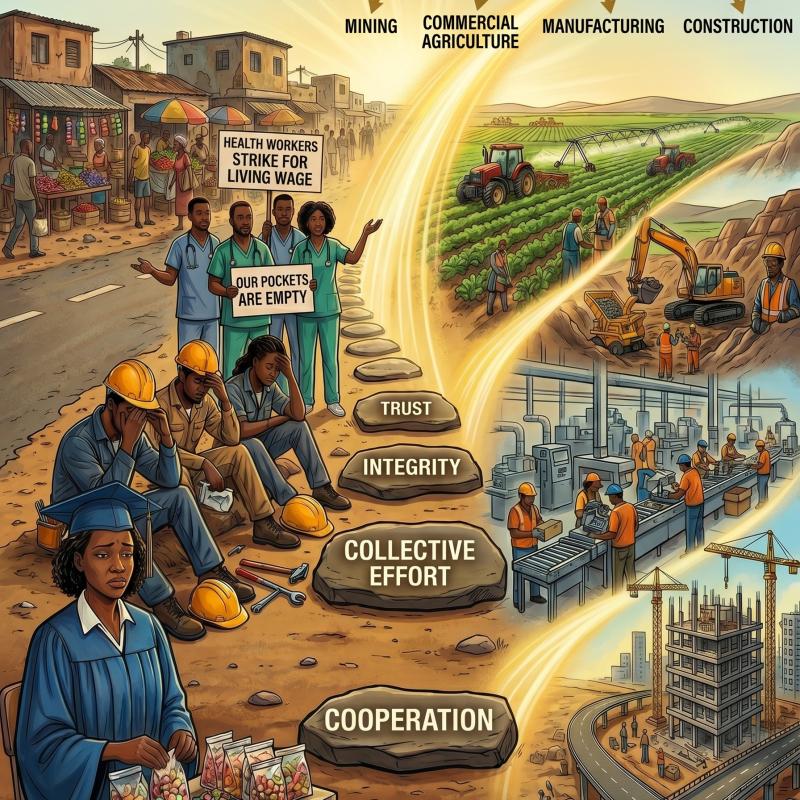
Caught between a heavy bag of hopes and empty pockets, African youth face systemic despair. Is looking inward via collective action the ultimate way out?
Lately, I have been consuming a lot of content. My feeds and bookshelves are filled with podcasts and literature about creating wealth, shifting to a money mindset, and escaping the rat race. Yet, when I turn to social media to see real-time commentary from my peers, the contrast is stark. African youth seem to be drowning in a profound sense of hopelessness and despair.
The despair is rooted in our everyday realities. There are systemic factors that genuinely place young Africans at a severe disadvantage, factors such as institutional corruption, incompetent leadership, fractured economic systems, staggering unemployment rates, and a crippling lack of access to capital. Without discounting or arguing with the harshness of the circumstances we find ourselves in, the question that has kept me awake at night is “What can possibly be a way out?”
Thinking long and hard about this set me on a quest for answers. In my professional life, my work in resource mobilization has given me a front-row seat to the inner workings of global development funding. Lately, massive funding cuts on traditional official development assistance (ODA) have left developing nations in a state of sheer panic, leaving communities even worse off than before. Seeing this macro-level retreat of international aid shows that old models of waiting for external salvation are dying. It forced me to look into how we can create sustainable wealth on the continent and shatter the state of dependence and paralysis gripping so many young people.
The Mismatch of Imported Solutions
The answers I have been finding online, as well-meaning as they try to be, are heavily biased toward developed Western contexts. They thrive on systems that work; seamless banking, structured investment portfolios, and robust retirement schemes. Being Zimbabwean, I know firsthand just how detached these solutions are from our reality. I belong to a generation that has witnessed our parents lose their life savings not once, but twice, to hyperinflation and abrupt currency overhauls. What can wealth creation look like in an ecosystem defined by inconsistent systems, highly skewed opportunities, and limited access?
In my own journey, I had the privilege of interviewing dozens of young entrepreneurs in Zimbabwe. Many of them started with nothing but an idea, a raw skill, or a hobby, and managed to build thriving businesses through sheer grit. Their stories are deeply inspiring and affirming of the resilient African spirit. Yet almost all of them expressed a shared bottleneck of a severe lack of access to capital that continuously caps their growth and stifles their true potential. Despite their challenges, they are among the few who have found a way around the challenging system, what about the other young person?
What about the young person who is completely stuck in a feeling of doom and gloom? The one sending out countless job applications into a void? The one trapped in a soul-crushing job they absolutely hate, or worse, the one with no income at all, trying to stay hopeful in an environment that offers zero reassurance? There is so much talk about "mindset shifts," but it is incredibly difficult to stay afloat when the surrounding environment offers no clear exit. The massive divide between the haves and the have-nots breeds a distinct kind of exhaustion. So, where do ordinary young Africans start when they have negligible savings, no investment capital, yet carry a heavy bag of hopes and dreams?
Looking Inward: The Power of Ubuntu
Perhaps the answer does not lie in looking outward for models that do not fit our context. Perhaps it lies in looking inward, toward something we have always known. I am always compelled when global leaders speak about domestic resource mobilization for Africa. It makes me wonder about what it would look like if it could be driven directly by the youth.
As Africans, we have always been a people who find strength in togetherness. We are anchored by Ubuntu—the profound understanding that I am because we are. From time immemorial, our communities have leveraged collective power to survive and thrive. We have built micro-savings through stokvels/mukando, given dignified send-offs to our loved ones through burial societies, and today, we see collective housing cooperatives mushrooming across our neighborhoods to secure land. Imperfect as they may be, they have worked.
We already know how to pool resources to survive. What if we pooled those same resources at a much larger scale to build generational wealth and escape the current quagmire?
Imagine the scale if five million young Zimbabweans made a contribution into a single, pooled fund
If millions of young people between the ages of 18 and 45 unified their financial capacity, we could go much further together than we ever could taking isolated, exhausting shots at the system alone. Individually, a $20 contribution here or a $50 investment there feels entirely insignificant against the backdrop of massive industries like real estate, commercial farming, manufacturing, or mining. But imagine the scale if five million young Zimbabweans made that exact contribution into a single, pooled fund?
The common rebuttal is that young people simply do not have that kind of money. But I argue that where there is a will, there is a way. We routinely see young people mobilizing resources overnight to buy the latest fashion items or smartphones. If we can prioritize consumerism, we can also prioritize creating a financial vehicle designed to change our economic destiny.
Becoming Our Own Safety Net
Micro-contributions, when aggregated, can provide young people with formidable financial leverage to meaningfully participate in and develop African economies. A fund of this scale would enable youth to invest directly in high-yielding industries, while simultaneously creating a capital reserve from which members could borrow at lower interest rates and friendlier terms.
We ought to grab the bull by the horns because no one else is coming to save us. Government youth programs have repeatedly failed due to politicization, and traditional banking institutions have locked us out. We must become our own safety net, create our own jobs, expand our small enterprises, and refuse to fold our hands in blame.
This solution is neither perfect nor easy. It requires a radical level of trust, discipline, and uncompromising accountability that is incredibly difficult to maintain. When I was parsing through this idea with my friend Mwansa, she raised a vital warning; The Tragedy of the Commons. She asked me, "If millions of young people pool resources, who will be accountable for it? To whom does the money belong, and what will stop the funds from being embezzled the same way well-meaning public funds have been in the past?"
After thinking hard on her critique, my mind turned to the United Nations, an institution now in its 80th year. It is an organization founded entirely on pooled funds from sovereign member states. Through rigorous policies, strict compliance guidelines, and clear accountability structures, it has sustained a global impact for nearly a century. This proves that it can be done. Complex, large-scale financial governance is not impossible; it just requires intentional design.
No single person among us knows it all, but the capacity, talent, and brilliant skills we need already lie directly within our demographic. We have accountants, the lawyers, the fund managers, and the tech innovators. What is missing is the structure to bring these elements together. We have the collective intellect to design this vehicle, and from among ourselves, we can elect leadership defined by both exceptional skill and absolute integrity.
Individually, fighting the current economic narrative is an uphill, isolating battle. But through Ubuntu, as young African people with a desire to do something truly great, we can build a mechanism that rewrites our story forever. The question is no longer whether we have the potential, it is whether we are willing to trust each other enough to begin.